How Solar Flare Activity Disrupts Timing Patterns in Global Mobile Poker Tournaments and Live Dealer Sessions
Written by Nils Butler · Jun 15, 2026
How Solar Flare Activity Disrupts Timing Patterns in Global Mobile Poker Tournaments and Live Dealer Sessions
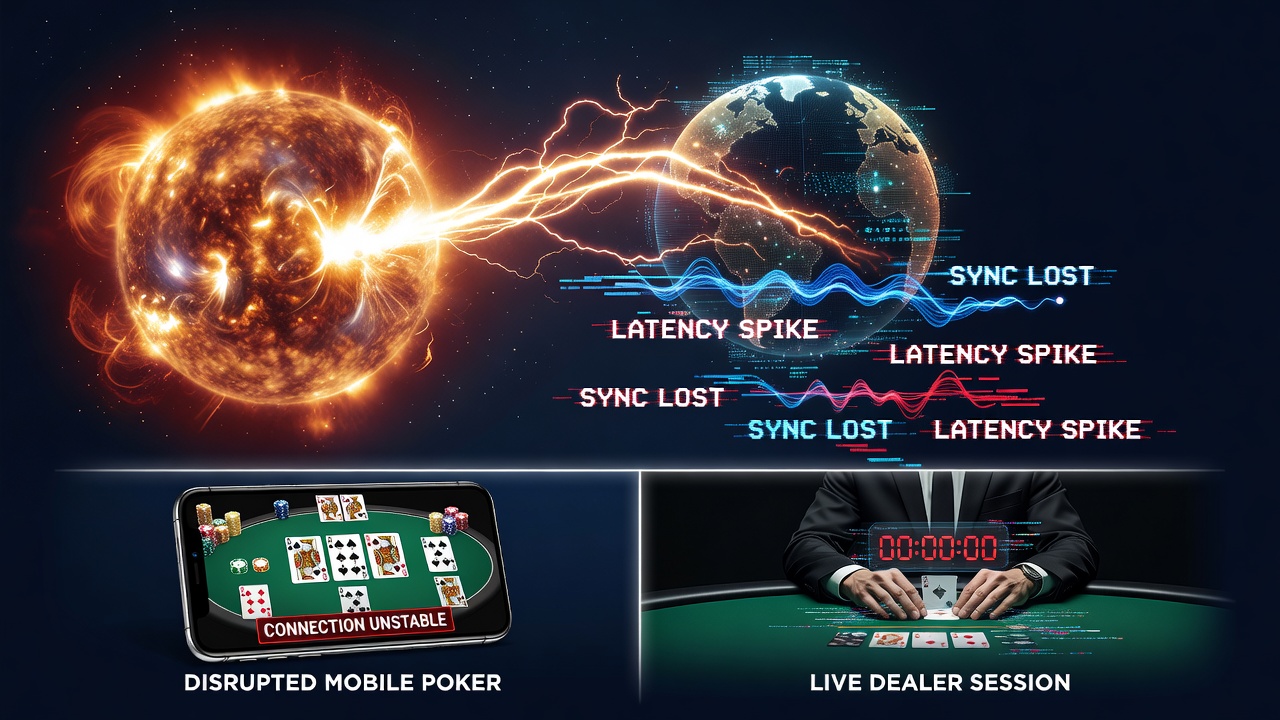
Solar flare activity has produced measurable effects on satellite-based timing systems that underpin mobile poker tournaments and live dealer sessions across multiple continents, and data collected through 2026 shows clear correlations between geomagnetic disturbances and delayed hand resolutions in digital card rooms. Operators track these events because precise synchronization determines tournament blind levels, dealer rotation schedules, and payout triggers in real-time environments.
Mechanics of Solar Flares and Signal Interference
Solar flares release bursts of electromagnetic radiation that reach Earth within minutes, while associated coronal mass ejections trigger geomagnetic storms that last hours or days. These storms ionize the upper atmosphere and create rapid fluctuations in the total electron content of the ionosphere, which directly alters the propagation delay of GPS signals used by mobile devices. Research from the National Oceanic and Atmospheric Administration indicates that L1 and L2 frequency bands experience phase shifts of several meters during moderate to severe storms, and this shift translates into timestamp errors ranging from 10 milliseconds to several hundred milliseconds depending on receiver location and satellite geometry.
Live dealer platforms rely on sub-second synchronization between video streams, betting interfaces, and central servers, while mobile poker applications use GPS-derived time to enforce blind increases and tournament start times. When signal integrity degrades, devices fall back to less accurate network time protocol sources or internal clocks that drift during extended outages.
Observed Effects on Tournament Timing
Global operators recorded increased instances of hand-timing discrepancies during the geomagnetic storm that peaked in early June 2026, and regional data from North American and Asian server clusters showed staggered blind announcements separated by intervals of 2 to 7 seconds. Players in affected zones experienced frozen bet timers or premature auto-folds when their local devices received conflicting time stamps from satellite and terrestrial sources. Tournament directors responded by extending blind levels manually in some cases, which preserved prize pool integrity but altered expected session durations.
Regional Variations in Disruption Patterns
Latitude plays a significant role because geomagnetic effects intensify near the poles, and operators serving Nordic and Canadian markets reported higher rates of timing drift compared with equatorial regions. European data centers experienced secondary effects when transatlantic fiber routes passed through areas of high ionospheric activity, creating latency spikes that compounded the primary GPS issues. Australian platforms noted shorter but more frequent interruptions during the same period because their satellite visibility windows overlapped with peak flare intensity.
Live Dealer Session Synchronization Challenges
Live dealer environments face additional complexity because video encoding, audio mixing, and player input processing must align within tight tolerances. When GPS timing falters, the mismatch between dealer actions and player bet windows widens, and systems designed to auto-resolve disputes based on exact millisecond logs encounter conflicting records. Several major platforms implemented fallback protocols that freeze betting windows during detected anomalies and then resume with adjusted timestamps once signal quality recovers.
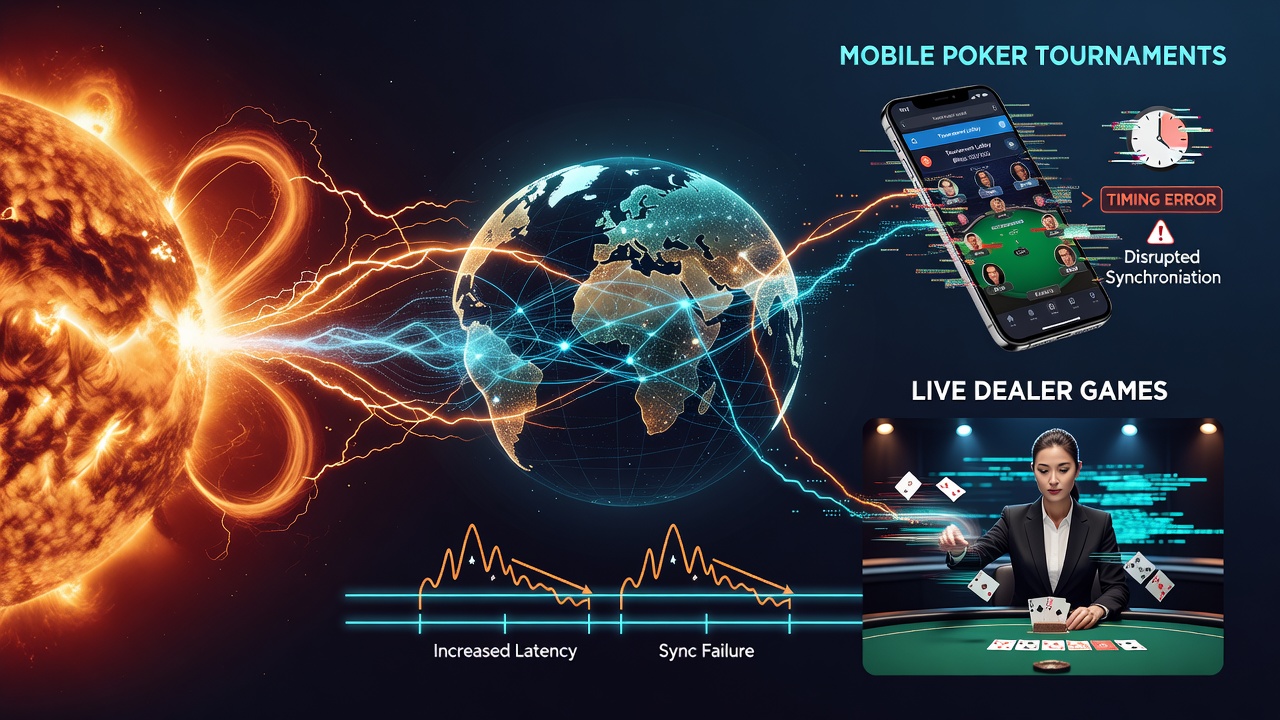
Industry reports from the European Space Agency highlight that solar cycle 25 reached elevated activity levels throughout 2026, and multiple documented events exceeded the thresholds that previously triggered aviation and maritime timing advisories. Gaming operators now monitor the same space weather alerts that guide those sectors because the underlying infrastructure shares common dependencies on precise satellite navigation.
Mitigation Strategies Employed by Operators
Platform engineers have introduced multi-source time verification that cross-checks GPS against terrestrial atomic clock feeds and distributed ledger timestamps, while some providers maintain redundant connections through low-Earth orbit satellite constellations less susceptible to ionospheric distortion. Tournament software now includes configurable tolerance bands that allow automatic extension of decision windows when detected drift exceeds preset limits, and live dealer studios maintain manual override capabilities for stream alignment. These measures reduce but do not eliminate the impact during severe events because the fundamental physics of signal propagation remains unchanged.
Regulatory bodies in several jurisdictions require operators to log timing anomalies and report significant service disruptions, and figures from the Canadian Gaming Association show a modest increase in such filings during the first half of 2026 that aligns with documented solar activity peaks. Observers note that transparent disclosure helps maintain player confidence when sessions experience temporary irregularities beyond operator control.
Future Monitoring and Infrastructure Adjustments
Continued solar activity through the remainder of solar cycle 25 suggests that timing resilience will remain a priority for mobile and live gaming infrastructure, and research institutions continue to refine models that predict ionospheric effects on specific frequency bands used by consumer devices. Operators evaluate upgrades to dual-frequency receivers and enhanced error-correction protocols that can maintain accuracy even when primary signals fluctuate, and collaborative efforts between space weather agencies and telecommunications providers aim to deliver earlier warnings tailored to latency-sensitive applications.
Conclusion
Solar flare activity produces documented disruptions to GPS-dependent timing systems that support global mobile poker tournaments and live dealer sessions, with effects observed across multiple regions during elevated activity periods in 2026. Data from space weather monitoring organizations and industry incident reports establish clear links between geomagnetic disturbances and synchronization anomalies, prompting operators to implement layered verification methods and adjustable tolerance protocols. As infrastructure evolves to incorporate additional timing sources and predictive alerts, the industry continues to adapt to these natural phenomena while maintaining operational continuity for participants worldwide.